Marketing

How Agencies Use Call Analytics to Show Real Performance

Proving Client ROI: How Agencies Use Call Analytics to Show Real Performance

In 2026, agencies don’t lose clients because of bad marketing. They lose clients because they can’t prove ROI clearly. Clicks are easy to show.Impressions look impressive.Traffic graphs are visually satisfying. But clients ask one question: “How many paying customers did this campaign generate?” And if your client’s business relies on phone calls, your answer must include call data. This is where most agency reporting falls short — and where call analytics becomes a competitive advantage. The ROI Reporting Problem Most Agencies Face Let’s be honest. Your monthly report probably includes: But what happens when: If you’re not tracking and analyzing calls, you’re showing partial performance. And partial performance weakens client confidence. Why Call Analytics Is the Missing Piece in Performance Marketing Call analytics bridges the gap between marketing activity and revenue outcomes. It answers questions like: This moves your agency from reporting vanity metrics to reporting revenue signals. And that changes everything. How Agencies Use Call Analytics to Prove Real ROI Here’s how smart agencies use call analytics strategically: 1. Show Channel-Wise Call Performance Instead of saying: “Google Ads drove 1,200 clicks.” You say: “Google Ads generated 48 inbound calls, 31 were qualified conversations.” That’s a completely different level of reporting. Call analytics allows you to break down: Clients don’t just see traffic. They see impact. 2. Measure Call Quality, Not Just Quantity Not all calls are equal. Some last 20 seconds.Some last 8 minutes. Longer, engaged calls often indicate stronger buying intent. With call analytics, agencies can: Now you’re not reporting “number of calls.” You’re reporting “number of high-quality calls.” That builds authority in client meetings. 3. Identify Missed Revenue Opportunities Here’s a powerful insight many agencies uncover: Missed calls = missed revenue. With proper call analytics, you can show: Imagine telling your client: “Your campaign is generating 60 calls monthly, but 14 are missed during non-business hours.” That shifts the conversation from marketing performance to operational improvement. You become a growth partner — not just an ad manager. Because clicks don’t close deals. Conversations do. How CallAtlas Call Analytics Helps Agencies Win Client Trust One powerful feature that makes this possible: CallAtlas Call Analytics Dashboard CallAtlas provides agencies with: Real-time call tracking Call duration insights Call logs & recordings Missed call monitoring Source-level performance data This gives you measurable, presentable insights. Instead of relying on assumptions, you show: Exact number of inbound calls Which campaigns drive conversations How long prospects are engaging Where revenue opportunities are leaking This transforms your monthly report from “marketing activity” to “business intelligence. Ready to Prove Real Performance? Start using CallAtlas Call Analytics to track, measure, and present the conversations that drive revenue. Request a Demo Turning Call Data Into Client Retention When agencies start using call analytics effectively: ✅ Clients understand where revenue comes from✅ Budget allocation becomes data-driven✅ Marketing decisions feel strategic✅ Trust increases✅ Retention improves Because when you prove impact clearly, pricing discussions become easier. You’re no longer defending spend. You’re demonstrating performance. From Vanity Metrics to Revenue Metrics There’s a difference between: “We increased traffic by 35%.” And: “We generated 52 qualified inbound calls. 18 converted into booked appointments.” Which one do you think keeps clients longer? Call analytics shifts the focus from surface metrics to revenue-generating conversations. And that’s where agencies differentiate in competitive markets. Are You Reporting Calls — or Just Clicks? Take a moment and ask yourself: Are phone calls included in your ROI reports? Can you show which campaign drives the most conversations? Do you know how many calls go unanswered? Can you prove call quality to your client? If not, there’s an opportunity to level up your reporting. Final Thoughts: Agencies That Prove ROI Win Marketing is no longer about generating noise. It’s about generating measurable outcomes. If calls are part of your client’s customer journey, they must be part of your analytics strategy.

Proving Client ROI: How Agencies Use Call Analytics to Show Real Performance Read More »

10 Reasons Why Call Leads Convert Better Than Form Leads in Marketing

10 Reasons Why Call Leads Convert Better Than Form Leads in Marketing

In marketing, success isn’t about generating more leads. It’s about generating leads that convert. And time after time, across industries like real estate, healthcare, legal services, automotive, and home services — call leads consistently convert better than form leads. Why? Because a phone call signals something powerful: Intent. If your campaigns are driving calls but you’re only measuring form fills, you’re optimizing for the wrong outcome. Let’s break down exactly why call leads outperform form leads — and how agencies can maximize their value. 1. Call Leads Show Stronger Buying Intent Submitting a form is passive. Making a call is proactive. When someone picks up the phone, they usually: Calls typically happen at the bottom of the funnel — where conversions happen. 2. Real-Time Interaction Speeds Up Conversion Form leads introduce delay: With phone leads, conversations happen instantly. Questions are answered immediately.Appointments are booked faster.Objections are handled on the spot. That shortens the sales cycle significantly. 3. Calls Build Trust Faster Trust is the foundation of conversion. With a form, communication is transactional. With a call, communication is human. Tone, empathy, reassurance, and clarity create confidence — especially for high-value services. People buy from businesses they trust.Calls accelerate that trust-building process. 4. Call Leads Are Pre-Qualified in Real Time When someone fills a form, you only know what they typed. When someone calls, you instantly understand: Sales teams can quickly prioritize serious prospects — improving close rates. 5. Higher Close Rates for High-Ticket Services Industries with complex or expensive offerings rely heavily on calls: These decisions require dialogue. Forms may initiate interest.Calls close the deal. 6. Reduced Fake or Low-Quality Leads Form spam is real. But a live phone call? That’s a verified, reachable lead. The quality difference directly impacts conversion rates. 7. Calls Enable Upselling & Cross-Selling A form doesn’t create opportunity for deeper selling. But during a call, sales teams can: This often increases average order value (AOV). 8. Better Campaign Optimization Signals Performance marketing thrives on data. If you optimize only for form fills, you may: Tracking call conversions allows agencies to optimize for: That’s smarter optimization. 9. Speed of Response Directly Impacts Call Conversions One of the biggest advantages of call leads is immediacy. But here’s the catch: If calls are missed, the opportunity is gone. Studies consistently show that the faster a business responds, the higher the conversion rate. That’s where infrastructure matters. 10. Smart Call Routing Increases Call Lead Conversion Rates Generating calls is only half the battle. Routing them correctly is what drives conversions. This is where CallAtlas Smart Call Routing & Call Forwarding makes a real difference. How Smart Call Routing Improves Conversions CallAtlas allows businesses to: Instead of: You ensure: For performance marketing agencies, this is critical. Because generating calls is meaningless if they don’t get answered. With proper routing and forwarding: That’s measurable performance impact. Form Leads vs Call Leads: The Real Performance Difference Form leads measure interest. Call leads measure intent. And with proper routing, call tracking, and conversation management, agencies can transform inbound calls into predictable revenue streams. Why Agencies Should Prioritize Call Infrastructure in 2026 Clients are no longer impressed by: They care about: If call leads convert better — and data proves they do — then agencies must: Because performance marketing isn’t about traffic. It’s about outcomes.   Turn More Calls Into Revenue with CallAtlas. Discover how smarter call tracking helps you convert high-intent leads into real revenue. Request a Demo Final Thoughts: Calls Close Deals Form leads fill pipelines. Call leads close revenue. And when combined with smart routing and forwarding through CallAtlas, agencies can ensure that every high-intent lead reaches the right person — at the right time. Because in performance marketing: The faster the conversation starts,the faster the deal closes.

10 Reasons Why Call Leads Convert Better Than Form Leads in Marketing Read More »

From Click to Call: Building a Full-Funnel Attribution Model for Agencies

From Click to Call: Building a Full-Funnel Attribution Model for Agencies

In digital marketing, clicks are easy to track. Calls? Not so much. For industries like real estate, healthcare, automotive, and home services, phone calls are often the highest-converting lead source. If your agency isn’t tracking calls properly, your attribution model is incomplete. Why Full-Funnel Attribution Matters More Than Ever Modern marketing is not linear. A customer journey may look like this: Click a Google Ad Browse the website Leave and return later See a retargeting ad Come back via organic search Call directly from the website If you are only tracking clicks and form fills, you are missing a major part of the buyer journey. The Biggest Attribution Gap for Agencies Phone calls often get attributed to Direct Traffic Paid ads don’t receive proper credit SEO performance appears weaker than reality Budget decisions are based on incomplete data What a True Full-Funnel Attribution Model Looks Like Traffic Source to Call Tracking Know exactly which platform drove the call — Google Ads, Meta Ads, Organic Search, Email, or Landing Pages. Campaign & Keyword-Level Data Identify which campaign or keyword generated high-intent calls. Call Quality Insights Track call duration, quality, and intent to understand real lead value. Revenue Attribution Measure which campaigns generate actual revenue, not just clicks. How CallAtlas Helps Agencies Build Full-Funnel Attribution Unique Number Insertion (UNI) for Accurate Source Tracking CallAtlas allows agencies to assign different tracking numbers to different campaigns and platforms. Buy tracking numbers directly from the portal Assign numbers to Google Ads, Meta Ads, SEO pages, or landing pages Track exactly which source generated each call Keyword & Campaign-Level Attribution Track which keyword and ad group generated each call and optimize based on real conversations. Call Recording & Lead Quality Analysis Access call recordings, call duration data, and missed call alerts to evaluate lead quality. Multi-Channel Attribution Dashboard Manage multiple clients and campaigns from a single dashboard and generate clear performance reports. Ready to Build a True Full-Funnel Attribution Model? Request a Demo How Full-Funnel Attribution Impacts Agency Growth Identify revenue-driving channels Reduce wasted ad spend Improve optimization speed Increase client retention Justify higher retainers with data-backed proof Final Thoughts: Stop Tracking Clicks. Start Tracking Conversations.   If your clients rely on phone calls, your attribution model must include them. Full-funnel attribution is incomplete without call tracking. Click → Visit → Call → Conversion CallAtlas helps agencies close the attribution gap and prove real ROI. Providing Unique Number Insertion Enabling campaign-level call tracking Offering actionable call insights Delivering clean, report-ready data

From Click to Call: Building a Full-Funnel Attribution Model for Agencies Read More »

How Marketing Agencies Lose High-Intent Leads Without Call Tracking

How Marketing Agencies Lose High-Intent Leads Without Call Tracking

Marketing agencies track everything. Clicks. Impressions. Cost per acquisition. Form submissions. ROAS dashboards. But here’s what many agencies still don’t track properly: Phone calls. And that’s where some of the highest-intent, highest-value leads are hiding. If your agency isn’t tracking phone calls accurately, you’re not just missing data — you’re underreporting performance, making flawed optimization decisions, and potentially losing clients. The Hidden Revenue Gap Most Agencies Don’t See Imagine you’re running Google Ads for a home services client. Your monthly report shows: 132 form submissions $52 cost per lead Stable conversion rates But what if 35 additional prospects clicked the ad, skipped the form, and directly called the business instead? If those calls aren’t tracked and attributed properly, they disappear from your reporting. You’re optimizing based on incomplete data. And incomplete data leads to incorrect scaling decisions. Why High-Intent Buyers Prefer to Call In many industries, phone calls indicate stronger intent than form submissions. Real estate. Legal services. Healthcare clinics. Automotive dealerships. Home improvement services. When someone picks up the phone, it usually means urgency, intent, and readiness to decide. Forms are convenient. Calls are intentional. The Client Retention Risk When you can’t clearly attribute phone-driven revenue: Your reports look weaker Your campaigns appear less profitable Your value becomes harder to defend Agencies don’t lose clients because ads stop working. They lose clients because reporting doesn’t prove revenue. How Call Tracking Fixes the Revenue Blind Spot Call tracking connects the full journey: Ad Click → Website Visit → Phone Call → Conversion → Revenue Instead of guessing which campaigns are working, you know. The Feature Agencies Need: Unique Number Insertion With CallAtlas, agencies can: Purchase and generate unique tracking numbers directly from the portal. Assign different numbers to different platforms Track calls separately for Google Ads, Facebook Ads, SEO, landing pages, and offline campaigns When each platform has its own dedicated tracking number, every inbound call is automatically attributed to the correct source. Unique Number Insertion makes attribution simple, structured, and client-ready. Ready to Prove Phone Revenue to Your Clients? Book a demo with CallAtlas today and see how easy it is to track high-intent phone leads the right way. Request a Demo Final Thoughts Clicks matter. Forms matter. But phone calls often close the deal. If your agency isn’t tracking calls properly, you’re only measuring half the funnel. With CallAtlas, agencies can track platform-level performance, attribute inbound calls accurately, prove ROI with confidence, and strengthen client relationships. Because agencies don’t grow by generating traffic. They grow by proving revenue.

How Marketing Agencies Lose High-Intent Leads Without Call Tracking Read More »

pay per call vs form leads

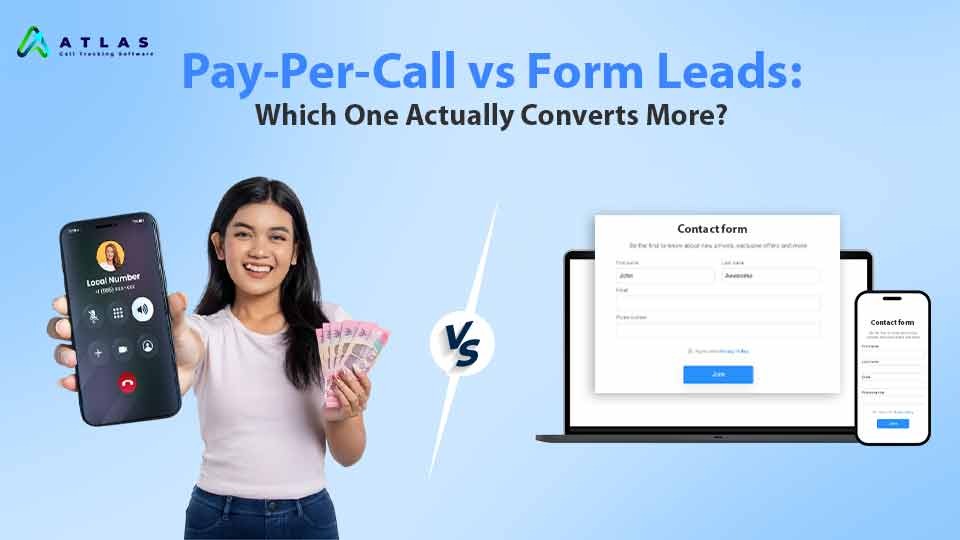
Pay-Per-Call vs Form Leads: Which One Actually Converts More?

In digital marketing, leads are everything. But not all leads are created equal. Some fill out a form.Some pick up the phone. And if you’ve ever managed campaigns, handled sales calls, or chased unresponsive form submissions — you already know there’s a big difference. So let’s settle the debate: Pay-Per-Call vs Form Leads — which one actually converts more? First, Let’s Define the Two 📞 What Is Pay-Per-Call? Pay-Per-Call is a performance marketing model where advertisers pay only for qualified inbound phone calls. These calls are typically driven by: Instead of paying for clicks or form submissions, you pay for real conversations. 📝 What Are Form Leads? Form leads are generated when a user fills out an online form with their name, email, phone number, and other details. These are usually followed by: Forms are common because they’re easy to implement. But ease doesn’t always equal effectiveness. The Real Difference: Intent Here’s where things get interesting. When someone fills out a form: When someone calls: A phone call requires effort.And effort signals intent. That intent is what drives higher conversion rates. Let’s Talk Numbers (Industry Reality) While conversion rates vary by industry, the general pattern is clear: Why? Because call leads are usually bottom-of-funnel. Industries where calls dramatically outperform forms: When urgency and money are involved, people prefer talking over typing. Why Pay-Per-Call Converts Better 1️⃣ Immediate Human Connection A form can’t: A live call can. Sales psychology proves that voice builds trust faster than text. Tone, confidence, reassurance — all happen in real time. That shortens the sales cycle. 2️⃣ Faster Response = Higher Close Rate With form leads: With pay-per-call: Speed wins sales. 3️⃣ Higher Lead Quality Form leads often include: Inbound calls?Almost zero fake intent. If someone calls, they’re real. And when you’re paying per qualified call, filtering (duration, geo, IVR routing) improves quality even further. 4️⃣ Better ROI on High-Ticket Offers If your average sale is: Then a high-converting phone call can easily justify higher acquisition costs. Pay-Per-Call thrives in industries where: Forms often work better for low-ticket or self-serve products. But Are Form Leads Useless? Not at all. Forms work well for: They are excellent for scaling volume. But volume doesn’t always mean revenue. The real question isn’t:“Which generates more leads?” It’s:“Which generates more sales?” And that’s where Pay-Per-Call often wins. Conversion Breakdown: Real-World Funnel Example Let’s imagine 1,000 visitors. Form Funnel: Final conversion: 1% of total traffic Pay-Per-Call Funnel: Final conversion: 2% of total traffic Even with fewer total leads, revenue doubles. This is why many performance marketers are shifting budgets toward call-driven funnels. The Psychological Advantage of Calls Here’s something marketers often overlook: People call when they are emotionally ready. They call because: Forms are passive. Calls are active. And active buyers convert. When Form Leads Might Win To be fair, there are situations where forms outperform calls: But when deals require persuasion, customization, or consultation — conversations outperform submissions. The Smart Strategy: Use Both The real winners don’t choose one. They design funnels like this: They: This hybrid approach captures every type of buyer. So, Which One Actually Converts More? If we’re talking pure closing power? 👉 Pay-Per-Call usually converts higher. If we’re talking volume and automation? 👉 Forms scale easier. But if your goal is revenue — not vanity metrics — calls often deliver stronger ROI. Because at the end of the day: Forms collect data.Calls close deals. Final Thoughts: Follow the Revenue, Not the Trend Marketing is full of trends. Chatbots.Automation.AI forms.One-click funnels. But human conversation still wins when money is on the line. If your business depends on high-quality, high-intent leads, it might be time to ask: Are you optimizing for submissions…Or for sales? Because when the phone rings with a qualified prospect, that’s not just a lead. That’s opportunity. 📞 And opportunity converts.

Pay-Per-Call vs Form Leads: Which One Actually Converts More? Read More »